The end of the rains in Senegal has brought the beginning of the cold season. At first I couldn't believe that any weather, day or night, could ever be considered cold. I burst out laughing each night someone walked by wearing a huge puffy jacket I would reserve for the harshest winters of Chicago, but, as embarrassing as it is, more recently I've found that the nights have gotten a bit chilly. Unfortunately most days are still as hot as they have always been
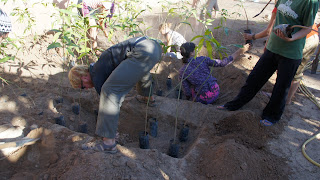
At site I continue to perfect my Pulaar which has been progressing quite well. I also continue to plan projects with people who approach me with an idea. Among the projects that I've planned include many live fences, where you plant trees at a narrow spacing instead of using dead wood. These live fences tend to require less care than a dead fence, and Senegal offers a number of species that not only grow quickly but grow quickly from cuttings - literally branches cut from an established tree and planted in the ground. I've also planned a few fruit tree orchards of varying size. These orchards often include just mango trees or cashew trees.
The beginning of December brought the West African All Volunteer Conference where every volunteer from Senegal and many volunteers from countries all over West Africa descended upon the Thies training center to share case studies, best practices and techniques with one another. The next two weeks of December at the training center was In-Service Training (IST). During IST I learned a number of skills that I plan to extend and teach to the people of Senegal. we also . The most interesting skill we learned as an Agroforestry group was grafting. With fruit tree species and, more popularly, mangoes you can think of the plant as two parts: the root stock and the fruit-producing branches. To improve yields and harvest desired types fruit one can take the specific root stock from the target environment and attach the terminal branch from a separate tree of a desired variety fruit, a scion. You attach this scion by cutting into the trunk of the desired rootstock and aligning the three layers of the branch. Afterward you wrap the attached branch in plastic wrap. After a few weeks you can tell if the new branch is starting to grow with the rest of the tree.
After IST I went back to Mbour to visit the Pulaar I had completed my training with. They of course welcomed me with open arms and were ecstatic to have me back. It was amazing how different of an experience it was to live there and actually be able to communicate with them at reasonably comfortable level. One evening I was back with the homestay family my two youngest siblings, Demba and Yazzi, were practicing reading and writing French letters under the supervision and instruction of Tijan, a late teen who has been living with the Mbalos and working in Mbour for many years now. Tijan clung fast to a stick as the two 6 year-olds wrote on their miniature chalkboards. If one of them made a mistake in reading or writing they would often have to answer to the crack of that stick either on the arm/hand or even head. As I watched and reflected on this style of teaching for two young children starting school for the first time I decided that I could continue to watch. For a moment I thought of just going to bed and avoiding the situation completely, but it was the fear that I saw in the face and tense shoulders of Yazzi, one of the cutest and happiest children I have ever met, that forced me to step in.
I knew I could not simply jump in and say "stop!" - though that is what I wanted to do. Instead I chose to be more tact. I knelt down next to Yazzi and her chalkboard and interjected my teaching style. I proceeded to coach her on how to complete each letter. When she made a mistake, I would remind her the technique she should use; sometimes even slowly moving her small hand across the chalkboard with my own. When she eventually started writing the letters correctly I praised her and reminded her that she "can do it." By the end of the lesson she was laughing and smiling with each correct letter, and Tijan wasn't going to beat a child who was completing the lesson correctly and laughing while doing it.
I then decided to go a step further and inquire to my host mother, Dianaba Kande, whether or not she thought the beatings made Demba and Yazzi like or dislike studying. After a few moments she admitted that it didn't seem like they were enjoying it at all, and she even agreed that it was likely interfering with their ability to learn. I asked "if I told you to come here but beat you every time you came, would you want to keep coming back?" Dianaba was quick to see the analogy and thought that the encouraging method of making learning fun was likely more effective.
One must understand how common beatings are in Senegal. Children as young as 2 are beaten for disobeying their parents. My host siblings just like their parents received beatings and their parents before them.
The next day the subject of beatings reared its head again at the house. Beatings are regularly used as jokes as well, but I actually wanted to get some discussion on this subject. I asked Dianaba if she would want Amanetta, the oldest daughter at 11, to beat her own children when she was old enough to have some? She quickly responded "No."
"Should you beat them, if you don't want them to beat theirs?"
Not more than 3 hours later into the afternoon was there hollering in the compound as Yazzi had hit another neighborhood child in the face and wounded her eye. Dianaba turned to me and voiced the fact that she "wanted to beat her a little bit, but you (Curtis) disagree." I dug deep and asked where Dianaba thought Yazzi learned to hit the other neighborhood child? A silence came over the group, and Dianaba eventually pointed a finger at Amanetta. Amanetta defended herself stating that no, it was in fact from their mother that Yazzi had learned to hit. I could not help but to grin at the ensuing silence.
"What do I do to punish them then?"
"I am not here to tell you what to do. These are your children. This is your family. It is not my family. You can do whatever you want. If you want to beat your children, I'm not going to tell you not to do it. I am here to simply give you something to think about. This is my job here in every facet. I am even teaching Agroforestry techniques that no one has to use, but it is about showing and teaching something new for people to think about."
I explained that in America parents will ground a child who has been bad, and that will be the end of their fun for the day, but that is not necessarily better. It is simply different.
Two days in Mbour with the homestay family and I was ready to head to Dakar. To get to Dakar one must brave the infamous Mbour garage, which is known for being especially tiring and annoying for foreigners trying to get somewhere. Luckily I was departing at a low-traffic time and didn't have any trouble that day. Whenever you want to travel in this country, and there isn't a Peace Corps car going that direction, you must brave the local garage. From the moment you get out of your taxi you have an onslaught of harassment. To begin with you usually have around five men yelling at you to see where you are going, most often trying to get you to take one of their more expensive taxis as opposed to the standard "7-place" (7 passenger station wagon) or "Alhum" (Mini-bus) that is already going to your destination as soon as it fills up. Next, from the moment you enter the garage until your car pulls out of the parking space you are a foreigner with a lot of money, and everyone who is selling anything wants you to buy their product. Cologne, fruit, nuts, sunglasses, hair-styling sets, caged parrots, mirrors, pre-paid phone cards, towels, hats, t-shirts, anything and everything is shoved in your face. The best strategy is to wear reflective sunglasses to keep them from noticing you looking at their product. If you don't have sunglasses, don't look anyone in the eye or show any interest in what is 6 inches from your nose. Otherwise you will make an unwanted friend and be pestered until you depart.
I always enter the garage on a mission to find my "7-place," pay might fare, and get out as soon as possible. I spend everyday making friends in Senegal; I don't need to make any more in a place notorious for pickpockets, hustlers, and people looking to pray on anyone looking like a tourist because they have a different skin color.
This attitude has also worked to my favor when I am faced with the task of negotiating baggage prices with someone that thinks I'm going to pay 2/3 the price of the ticket for my medium-sized bag to go in the trunk. I came into this country very uneasy about the prospect of bargaining for nearly (>70%) everything. In America almost everything has a set price, but here it tends to only be boutiques, travel fares, and established businesses that have set prices. I have since gotten quite skilled at negotiating for baggage. I not only have a better sense for what items should cost based upon their size, but I now speak a third language well enough to haggle in one of the Senegalese local languages: Pulaar.
I have done most of my distance traveling in the northern part of the country where Pulaars tend to be few and far between, and Wolof rules the land (I have been picking up a good amount of that as well though). This means that I enter a garage north of the Gambia speaking French, the language mostly of the educated Senegalese and the French tourists that pass through area. This means that it is often that a foreigner speaking French can expect to be asked to pay a higher price. A foreigner speaking a local language, however, gains a lot of credibility, and the Senegalese then assume you have been living here for a long time. This is reason why I get excited if I find a Pulaar-speaker north of The Gambia.
I always enter the garages of the north speaking Pulaar, but on a rare occasion I find myself starting to haggle in French, inquiring if he speaks Pulaar, confirming this ability, and "making it hail Pulaar." I have learned enough of this language to unserstand a good majority of what is said in a standard conversation, and I have the haggling expressions down well enough that I can rattle them off fluently. I proceed to make the man that wanted to charge me triple the reasonable baggage price wish that he didn't speak Pulaar and that he didn't stumble upon this foreigner who is very clearly no longer a tourist. I don't say anything mean or vulgar or threatening, but I use every idiomatic expression I know e.g. "You don't think my head has any water. My head has a lot of water. You think I'm a tourist. I am a Pula Futa (type of Pulaar) from Labe, Guinee-Conakry (city in Guinee where a lot of Pula Futas are from). You must be a kalabante (player, user, trickster), if you want that much money. How about $___ for the Senegal native that isn't a tourist." After a few minutes of insisting that I'm a Senegalese and not a tourist, I often get my price, and he'll think twice the next time he wants to cheat people out of money because they're American.
I spent Christmas in Dakar with a number of other PCVs where we executed some great festivities that included "Secret Santa" and "White Elephant." I put up a number of pictures from my time in Dakar on my Facebook account since the uploading time is much faster, but here is the link for non-facebook users to have a look:
http://www.facebook.com/album.php?aid=2046346&id=1146150057&l=188ff467b4
It was certainly an adjustment not to spend the holidays with the family, but I was glad to talk to some of you guys on speakerphone Christmas Eve. I hope everyone had a great holiday.
Next a number of volunteers traveled north to St. Louis for New Years where sandy beaches greeted us. Most PCVs stayed together in hostels on the islands, but we rarely spent much time in them other than to sleep. New Years Eve brought a free Akon (he's Senegalese) Concert to St. Louis, and I was incorrectly convinced that the event would not bring the issues I feared. The concert was entertaining, but unfortunately there were a number of issues brought by the crowds of people in attendance. Fortunately we were able to get past the issues and ended up having an otherwise great weekend traveling around the islands, swimming at the beach, and sampling the nightlife of the North.
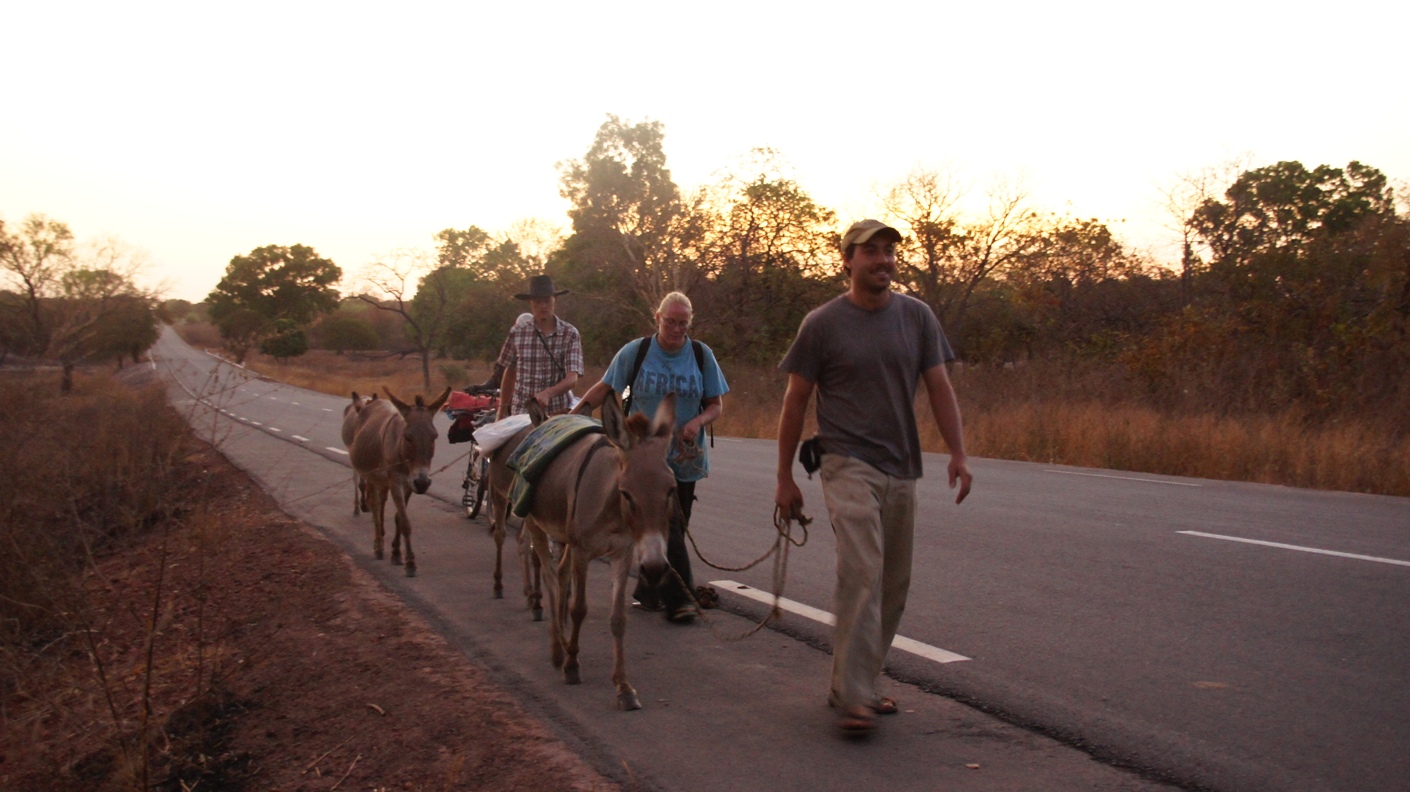
My return home included a 5-hour car ride St. Louis to Dakar on Sunday evening followed nearly immediately by a 9-hour car ride overnight Sunday night from Dakar to Kolda. Tuesday brought a 2.5 hour car from Kolda to Kounkane to film our Donkey Ride promotional video, and then a 1.5 hour bike ride on Wednesday from Kounkane south to my site.
Since being back I have gone through some slump rough periods followed by comfortable enjoyable days. After being gone from site for so long I expected a bit of readjusting and face it one day at a time - leaning on other PCVs to help me iron out the cultural difficulties I had to re-surmount. I am excited to be moving into my new hut soon after a long wait period, so things are looking up for now.
I have recently purchased an internet USB key that paired with my recently-mailed laptop (Thanks Mom & Dad & PCV Jason Haack) in theory will give me internet at site. Cross your fingers with me that I'll now be able to give more regular updates and skype from out in the bush. Stay tuned for status reports.
Finally a few older PCVs along with myself and a number of Senegalese Health Educators will be completing a 100km tour across the region of Kolda in March, and we've put together this promotional video for your viewing pleasure:
http://www.youtube.com/user/KoldaDonkeyRally
Scroll through the text box below the video for more information, logistics, and how you can potentially help. Thanks.
Hope everyone is doing well back at home. I truly appreciate the care packages I've received. Sometimes it's as simple as protein bar or some dried fruit that keeps my sanity and taste buds intact here.
Miss you and hope to hear from you soon