Friday, November 16, 2012

Moussa Diallo: Diaries from a Master Farmer


Within two weeks of my install, Moussa Diallo approached me with an interest in working together on a few projects he had in mind, and as a new volunteer I put him through a stronger vetting process to gauge his motivation and commitment. Very quickly Moussa proved himself to be extremely dynamic, patient, helpful, and knowledgeable as both a teacher and student.  Moussa was and will continue to be indispensible for future volunteers’ linguistic, cultural, and technical progress.  Despite leaving school at 15 years old to start farming to support the family, Moussa speaks perfect French, along with Pulaar, Wolof, and Bajaraanke, a minority Guinean language. He understands a surprising amount of English and makes note of the English names of techniques especially in relation to the field of Agriculture and Agroforestry. A natural teacher and curious individual Moussa will also do great things as a Master Farmer.


The Master Farmer Program is a relationship between Peace Corps and a well-respected individual farmer selected for his dynamic attitude, motivation, curiosity, and teaching ability. Every volunteer is not expected to find a Master Farmer; a Master Farmer finds a volunteer.  I recognized Moussa Diallo’s potential for this position early in my service, but it was his commitment throughout my two years that sealed his nomination. Through Moussa’s new relationship with Peace Corps he will be taught by official Peace Corps training staff in the best techniques for gardening, field crops, and Agroforestry. After being properly trained, Moussa then takes these techniques to a 1 hectare field, he already owns, for implementation.  Food Security Program funds (USAID) pay for the space to be fenced, a well to be dug, a storage shed and water basins to be built, and a full set of tools to be purchased.  After the site has been sufficiently set-up and the techniques established, Food Security funds also cover the cost of “Open Field Days” where the volunteer and Master Farmer hold trainings for other farmers in the local area. The project allows the Master Farmer to greatly improve his yield capacity while also extending these techniques to others in proper local languages and, in theory, for the remainder of time the Master Farmer is at that site. This is a much longer timetable compared to the 5 volunteer, 10 year average life of Peace Corps' involvement in an individual site.


Aside from my own trainings and lessons, Moussa attended his first formal Peace Corps staff-led Master Farmer Training in May 2012. He will continue to be periodically trained at the Thies Training Center.  With the remaining few months of my service in Pakour Moussa and I were able to begin establishing the infrastructure for the Master Farmer site. Approval from Peace Corps came in April, and Moussa and I began our search for a well-digger and began a tree nursery of live fencing thorny trees. The project’s well-digger presented a number of obstacles to completing the project in a timely manner, and unfortunately it was not finished until early September 2012, in the middle of the rainy season.  Given this reality, additional funding has been provided for deepening the well upon dry-up anticipated for spring 2013. In addition to the well, the chain-link fence has been established enclosing the entirety of the property.  Immediately inside the chain-link fence, over the course of a week in August 2012, Moussa and I outplanted a live fence consisting of 290 Acacia nilotica, 133 Acacia laeta, and 115 Parkinsonia Aculaeta mixed together. These thorny trees will be continuously groomed to grow together and make an unattractive barrier to goats, sheep, cows, and children.  Also, to date, all of the tools have been purchased to fully outfit the project. Remaining infrastructure establishment work that will be completed before replacement installation includes: the storage shed and 2 water basins.

Sunday, October 14, 2012

Do Ma Def Benin Att...I'm Doing Another Year!

October 20 officially marks the end of my two years of service in the small town of Pakour, Kolda, Senegal. Unfortunately, I won’t complete those two years in Pakour. On September 5th I arrived in Thies, Senegal where my journey first began August 11th, two years ago. Since that day I have, to use an almost criminal oversimplification, gained some perspective. Never could I have imagined that cultural and language differences that formerly frustrated me to no end would now be a thing of the past.

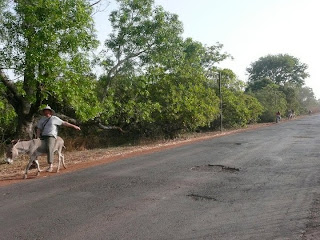
In 22 months in Pakour I planted or facilitated the planting of over 12000 trees with more than 60 farmers. These trees will continue to produce cashews, mangos, guavas, papayas, and pomegranates long after I leave. The thorny species will continue to protect farmers’ fields and gardens from goats, sheep, cows, and monkeys for years after I say my goodbyes.  I rode a donkey in 115° F heat 100 km across the region of Kolda to raise malnutrition awareness and teach the importance of the locally available super nutritious tree, Moringa oleifera. I led trainings in tree nursery establishment, outplanting techniques, and how to cook a leaf-based mosquito repellant lotion.  Mike Goldman, a volunteer friend of mine, and I gave a chuckle and peaked the scientific curiosity of anyone with a radio and 30 minutes to listen to facts and stories of the day. My service also contributed to the infrastructure of Pakour by giving 630 students and 25 teachers the dignity of bathroom facilities on school grounds, ending a 3-week student strike. When I leave, my counterpart and good friend Moussa Diallo will continue to use the resources and skills given to him through the Master Farmer Program to teach “best practices” in gardening, field crops, and agroforestry.

Many things have been accomplished in the 22 months I worked in and around Pakour, Kolda, Senegal, but now I take my skills to a new arena. My new job as Peace Corps Volunteer Leader (PCVL) officially started on September 26th with the arrival of 58 of some very qualified and motivated trainees clean and fresh from America. Starting with the training group’s Pre-Service Training (PST) I will be I will be at the Thies training center training the trainers on how to best extend Agroforestry techniques to Senegalese villagers in multiple languages and with a culturally-sensitive air. The focus of PST will be to welcome and guide the volunteers-to-be with just a bit of technical training, while the main focus will be to support them on the more treacherous and difficult road to cultural integration; their In-Service Training (IST), five months into their service, will be more of an intensive technical retreat. I have spent many meals going on at great length about my experiences travelling, living and working amongst the people of Senegal. I look at them, and strain to reflect back on how I was in their shoes.  Our Training Manager admitted in a recent staff meeting that "often their [PCVL's] opinions are taken more seriously...because they've been through it all." It is this knowledge from experience we will focus on for the next two months.

During their training they will, as I did, split time between their training family (for a language/culture focus) and the Training Center (for some more technical training). The part of training I look forward to the most however is Volunteer Visit when I will be able to take my replacement down to Pakour to show him what I've been doing for the past two years, introduce him to Moussa and the work partners, and discuss with him what Pakour would like from him.

Upon the completion of PST at the end of November, the trainees will be installed at their sites, and I will be home for a long-overdue 1.5 month vacation.

Thursday, September 20, 2012

The Tree Nursery

Moussa Diallo & myself have established
 and cared for this nursery
Citrus Seedlings (Left), Thorny Live-fencing (center),
Guavas (Right)
63 Mango Trees Ready to be Grafted

Citrus Seedlings (Front), Papaya Tree (center),
 Mangoes (Right)
A Mango Graft has Taken
Guavas (top left), Mangoes (front),
Thorny Live-fencing (top right)
Papaya Tree (left), Thorny Live-fencing (center-left),
Papaya Seedlings (center right)

Wednesday, September 19, 2012

Lundi Science ("Monday Science" en Anglais)


A LITTLE BACKGROUND
NPR (National Public Radio) has "Science Friday" where Ira Glass covers the current topics of interest in the world of science for a broad range of listeners. Occasionally guests are brought on to comment on a current event or give some special insight into their field of expertise and there is a "Video Pick of the Week" showcasing an internet-posted clip, but one thing is for sure, Ira will peek your interest into science.


Velingara is the the departmental captial on the east side of the region of Kolda about 60 km (3 hr) to the north of my site, where I often go for internet, banking, and post office needs. During my monthly/bimonthly trips to Velingara a fellow-volunteer and friend of mine, Mike Goldman, and I have an amusing time at local restaurants and sandwich shops poking fun at each other in our mutual local language of Pulaar - calling one a hyena, while the other is said to eat beans and have a big stomach (both very common joking insults with the Pulaar ethnicity). The salesmen and clientele die laughing at these two Americans laying it on each other in a language that they had never even heard westerners speak. For a year this was common practice until finally we were struck with genius.

In the Fall of 2011 Mike was having trouble filling the biweekly Monday evening half-hour radio slot he was responsible for when it hit him like a bolt of lightening. A frequent listener of the Podcast "Science Friday," hosted by Ira Glass, he thought, "why not do the same for the people of the greater Velingara area?" Mike immediately sent me a text message informing me of his recent brainstorm, and "Lundi Science" was born.

For the last year, Michael Goldman and myself have been meeting every other week to discuss and determine the subject matter for each radio show, research the scientific topics, write a script discussing the topicS in an entertaining manner, and finally translate it into Pulaar for radio broadcast. Topics have ranged from sports nutrition and medicine to endangered species and gardening techniques. We had an episode on the extinction of Black Rhinoceros, a "Question of the Day" on whether the United States or Senegal produces more corn, and a "Photo of the Week" featuring the Whale Shark on our Facebook Group. There was even an episode where a guest volunteer, with a degree in Soils Science, came on to be interviewed for his thoughts on composting; his Senegalese name was Abdoulaye Diamanka. Since my Senegalese family name of Barry and his of Diamanka have a "cousin relationship" this opened the script up to even more jokes and tricks than Mike and I usually have. It's this comical entertaining "cousinage joking/making fun of" aspect of the culture that we highlight while also giving people of Senegal, especially villagers who may have never seen much of the region much less the country, a window into the world of science.

I wasn't sure of the success of the show until I had this exchange with my counterpart, Moussa Diallo:

Moussa: "Dienaba (my host mom) is very interested in when the next episode of 'Lundi Science' is airing."
Me: "Oh yeah, she really likes the show? I didn't know she listened to it."
Moussa: "Yeah she really likes it. Because you can learn about things you've never heard of before."

Friday, September 7, 2012

They Say, "It's a Small World," but This Was Ridiculous

Before coming to Senegal to join the Peace Corps I studied Biology at Grinnell College in the rural southeastern Iowa town of Grinnell. While attending Grinnell a good friend of mine was Tibetan-born, Nepali-raised, Tashi Langton. Tashi was also a Biology major and we took many courses and completed many labs together while also earning our keep in the college equipment room folding laundry and renting out basketballs. Growing up in Nepal, Tashi attended the American International High School, Lincoln School, in the capital of Kathmandu before eventually coming to Grinnell in the Fall of 2006.

Flash-forward to August 2010 when I arrived as an Agroforestry trainee in Thies, Senegal where shortly after my arrival I received a message from Tashi asking if I had yet met his friend Peter Gill. "Peter Gill? Where would I have met one of Tashi's friends in Senegal when I had barely even left the Training Center?" Somewhat confused I put the question on hold and decided I would respond to Tashi in a day or two when I had the chance. Shortly thereafter, during some free time at the training center, I was greeted by a one Peter Gill, also a new Agroforestry trainee.

We immediately launched into a discussion about how it was he knew my college friend, Tashi.  Peter also grew up in Nepal where he attended a high school by the name of Lincoln School. At Lincoln, one of his best friends was a one Tashi Langton.

From an international high school in Nepal, Southeast Asia, to a small liberal arts college in rural southeastern Iowa, to the exact same training group and program in Senegal, West Africa, we had discovered a connection that would give you chills.

Sunday, July 29, 2012

Kolda or Bust...Better Not Jinx It


I awaken suddenly to rapping on my zinc door. “Who wants what at this hour?” I think. It’s still dark out and I can only assume it’s Moussa, my good friend and counterpart, waking me up to water our tree nursery. I sit up with a start and an expletive remembering I’m going to Kolda today, and since the skin infection on my shin still hasn’t cleared up after 3 weeks of antibiotics, I won’t be biking the 30 km from my village on the border of Guinea-Bissau to the paved road. I will have to take a car up to Diaobe, a large weekly market town to the north, before continuing another 90 km to the regional capital. I curse my phone as I check the time to see it’s 6:30 am instead of the 6 am I had set my alarm for.  Must have turned it off and fallen back to sleep; some things never change. Moussa insists we have time to water the nursery before I have to meet the car at the town center. He talked to the driver the night before anyway, so I will have a spot saved – most likely the front seat. We water the trees group by group with him pulling the nearly 17 m at the well and me shuttling the water through to behind my hut where roughly 1400 trees await. We have guava, mango, papaya, citrus, and three species of thorny live-fencing trees.

About 7:15 we head off down the road to find a lone station wagon with a number of people milling about around it. Like Moussa had arranged, the front seat has been reserved for me, and with about ten people standing around I assume it won’t be long before we leave. The station wagon, known commonly here as a “Sept-place” for the seven passenger spots in the car, can have up to eleven passengers inside the car: three in the front passenger/console seat, four across the middle, and four in the back. This however does not represent a full car. I’ve seen up to an additional fourteen loaded on the roof. I refer to these as “Vingt-cinq places,” and only for the lack of transport and distance do Pakour drivers get away with this severe offense in the face of the military checkpoint before Diaobe. Just once I even saw a guy ride on the passenger side of the hood! We load up a few more on top, I wish Moussa well and thank him, and we’re off.
Travelling from my village to the regional capital of Kolda requires a 40 km leg plus a 90 km leg punctuated by waiting at a garage to switch cars.  The first leg of 30 km north to the paved road along a rocky clay (latterite) road going from gaping pothole to gaping pothole, in a “sept-place” takes about 45 mins to an hour in the dry season (November-May) and 1 hour to 1.5 hours when the potholes give way to ponds during the rainy season (June-October). On a bike I can cover this distance in 1.5 hours. One infamous driver is known for taking this route at Mach 3, but since the accident that sent the car rolling down the latterite, most passengers opt-out of getting a ride from him. I don my cloth head wrap to shield myself from the dust, and the ride is rather agreeable.

As we get close to our destination, I take my headphones off and get into “Diaobe mode.” Diaobe consists mostly of a 2 km stretch of road flanked by vendors as far as the eye can see. Wednesday is “Louma Day” (weekly market) and Diaobe is transformed into the largest outdoor market in all of West Africa. Disembarking from my “Vingt-cinq place” I’ve zipped up all the pockets in my backpack, my camera bag hangs in front of me where I can see it in my periphery, and I clutch my laptop a little bit tighter.  I ignore the countless calls of “my friend,” “americain,” “toubab” and walk at a brisk pace through the market, much faster than anyone around me, trying to stay in the middle of the road where foot traffic is lowest.  This can prove difficult to maintain, however, given that on Louma Day the congestion can be so bad it could take up to ten minutes to cover the 2 kilometers of national highway in a car. I stick out, but I know it and I keep moving keeping one eye over my shoulder. I’ve heard of volunteers having the bottom of their bag cut out by attempted thieves, and even of a motorcycler alerted by his passenger as someone tried to swipe his cell phone from his shirt pocket while negotiating the crowded street.


Making it to the other end of Diaobe I relax with sigh at seeing the familiar garage workers Mammadou Baalde and Mammadou Jang; I’ve been here a few times. Greeting them with a smile they show me to an empty car pointing out that the car in front just filled. The more spacious front seat is a mixed blessing. I’ll have to wait until enough people come along willing to pay the slight premium for faster transport with the sept-place as opposed to the slower white bus known locally as a “Ndiak Ndaye” or “Alhum” in Peace Corps volunteer speak for the “Alhumdilulih” (thanks be to God in Arabic) painted on the hood of every single one in the country. Generally on Louma Day travel to and from Diaobe is easier with the increased market traffic. I wait about an hour, and the car is full (only seven passengers this time).

The second leg of 90 km starts with 40 km of perfectly paved brand-new road followed by 50 km of the worst road you’ve ever seen in your life. In simple quantities: it takes 2-2.5 hours to cover 90 km (60 mi).  The drivers covering this stretch of road are either the most skilled navigators or the biggest off-road junkies there are.  Literally swerving from one shoulder to the other attempting to avoid the worst potholes I can’t imagine ever succumbing to seasickness after going through this. There are also four military checkpoints along the road to Kolda.  I remember the first few times being a little unnerved by the man wielding an M-16 peering in our car, but such is the standard here. Most often they ask for identification and tell us we can move along.

Finally arriving in Kolda I grab a taxi, and I’m off to the Peace Corps Regional house for (normally) more reliable electricity and running water. I could use a western-style shower after my 6 hour, 120 km (75 mi) journey.

Wednesday, July 11, 2012

Pulaar and Wolof (But French Just In Case)


Pulaar is a great language for navigating the south of Senegal and even West Africa in general. As the second most prominent language on the whole continent, I was pretty content with it as my given local language. Before installation at site in the southeastern arrondisement (sub-regional city) of Pakour in the region of Kolda, I spent two months living with a Pulaar family in the big city of Mbour. Residing about an hour and a half outside of Dakar, the family made a concerted effort to only speak Pulaar during my stay, but in reality they would have been much more comfortable mixing in the most popular Senegalese and more northern prominent language of Wolof. A fact that would later be confirmed upon my future visits to their compound.

When travelling in Senegal you are hard-pressed to find Pulaar-speakers north of the The Gambia. Among the many other ethnicities (and consequently languages) including Sereer, Mandinka, Jolla, Bajaraanke, and Bambara the vast majority of people will also speak Wolof.  Generally the bigger the city in Senegal, the more Wolof you will find. Also, any national or international office or business (banks, post offices, mayor’s office, community rural, governmental officials, Orange Phone Service, police, gendarme, military) anywhere in the country will most likely be run by Wolof-speakers.

Travel is also, for the majority, run in Wolof/by Wolof-speakers. When you walk into a garage, hail a taxi, negotiate for baggage prices for a car, bus, or mini-bus, you are likely working with someone that either learned Wolof as his first language or is accustomed to dealing in Wolof.  It is for this reason that the Peace Corps prefers to reserve sites far from the capital for volunteers with a strong French background. Those volunteers will then learn a more minority local language while being able to rely on their French, the official national language, for travel.

I studied French for 12 years before coming to Senegal but had never been to a French-speaking country and was thus afforded with a wealth of vocabulary but a lack of fluency and confidence in my proficiency. Since my arrival, I have solidified the fluency I’ve been striving for, however, in my opinion, this does not suffice Senegal.  With one glance a vendor or apprenti (ticket seller on the back of a vehicle) has sized me up as an ignorant tourist, and French-speaking only serves to confirm this prejudgment.  Immediately I become the subject of inflated prices and ostentatious speaking.

Fortunately my living situation with 5 Wolof-speaking teachers has afforded me a convenient and quick means of picking up the language.  When conversing with them, we all speak French, Mr. Gaye (an exceptional English teacher) and I can speak English, they teach me Wolof, and I teach them Pulaar. With a lot of patience on their part, now I can even hold down a conversation in Wolof.  This fourth language has become my travel language of choice.  In Wolof, I’m no longer some touristy Toubab (westerner/white person) lost in the world hoping for someone to hold my hand. In Wolof, I’m an insider who has his wits about him…and I can always fall back on French when things get hairy.

Friday, December 9, 2011

A Kolda Thanksgiving


Tobaski Pics


Trainings and Such

Part of being a Peace Corps volunteer is finding that imperfect balance between the amount of work you execute (e.g. number of trees grown/planted) and the amount executed by host-country nationals (HCN). It would be very easy to grow a bunch of trees myself and then hand them out or just go plant orchards on my own. I wouldn't have the back and forth trying to determine what the HCN really wanted to do. I wouldn't have to make sure they attended the training at every step, and then executed every step correctly. But the more work I take on, the less likely it is to continue on after I leave or after Peace Corps leaves the community. Trees might be considered "Amadou's (that's me) trees" and won't be cared for. HCNs might expect from my replacement the same handouts I gave during my service. (To the left is my back yard and the trees I have in my nursery).


Over my first year at site I have really taken this philosophy to heart and insisted on not ever forcing doomed projects on people, handing out trees or tree sacks to anyone who stops by, or working in someone else's field without their help. I've also executed a number of trainings and demonstrations to get people learning the process work.
My first training was establishing a cashew tree pepineer (Pictured Left). This included preparing the soil mixture, filling the black plastic tree sacks, treating the seeds, and setting up a nursery site. With trees started in the nursery you can get them growing a month or two before the rains are established, so they are already healthy and strong before outplanting, when they can really take off.

I have since also completed trainings in citrus and mango rootstock bare-root bedding. This involves direct seeding citrus or mangoes in a germination bed to allow for adequate establishment and selection of the best seedlings to transplant into tree sacks before grafting the following spring and eventually outplanting. If there is a multi-step process, I give them the first step in a training and then tell them to come find me when they're ready for the next. This effectively weeds out those that aren't really interested in working on their own.
Malaria killed 780,000 people worldwide last year and continues to be a serious issue in Senegal. In my host family alone 6 people contracted malaria this year alone. PC Senegal has made great strides in bed net distribution and preventative action. I completed two trainings on preparing mosquito repellant based on leaves of the locally available neem tree. You simply boil the water; add leaves, oil and soap, and then stir to cool. The lotion is quite effective and inexpensive. This was my best-attended training.
The following day my host mother Jennaba (right), my friend and workpartner Moussa (left), and my namesake Amadou (center) got together to try out the process and make the lotion themselves. I'm told another who attended the training is now making it and selling it in the bigger city of Velingara.

Monday, September 19, 2011

Parc National Niokolo-Koba

At 4am on Thursday I met three guys from England driving the return leg of Sierra Leone to London after working at a hospital there for two months...We decided to go to the National Park for the night...

Here are some pictures from the trip (blog post upcoming)


And then he went to the trunk to get a tire iron...

I was in Dakar about a week ago to complete my mid-service medical appointments where they run a number of tests to make sure Senegal isn't killing me yet. Dakar always offers a number of big city headaches you would never run into in regional capitals, much less a village. One of them is the obstacle of negotiating a taxi fare wherever you're going. As a white foreigner I have a sign on my back that says I have a whole lot of money, and anyone and everyone should try to get as much of it out of me as possible. Fare negotiations always start with something ridiculous like 4000 or 5000 CFA. I often throw out the Wolof karma proverb, "Luway def bopem," and the entire dynamic of the conversation changes: I am no longer a tourist, I speak some of the most prominent local language, and there is no way you're getting 3-4x the fair price like you're accustomed to with other foreigners. We joke around a bit more in the small amount of Wolof I speak, usually calling each other "sai sais" (thugs), and in the end we settle on around 1000-1500 CFA for the fare.

Around 4pm on Sunday afternoon myself, Jesse, another Peace Corps Senegal volunteer, and Virginia, a former Peace Corps Togo volunteer picked up a taxi in front of the "Liberte VII" Peace Corps transit house in Dakar negotiating the standard 1500 CFA price to the "Brioche Doree" bakery round point in Ngor Village (northwest Dakar) as the waypoint to go another ~200yds to the Peace Corps Senegal office. Nearly every taxi driver in Dakar knows this waypoint and has no trouble getting to it.

We negotiate the price, load our bags in the trunk, and depart for Ngor. Along the way I ask the driver if he speaks any Pulaar so maybe we can have an actual conversation, but he doesn't. The beach comes into view and we arrive at the first round point in Ngor with the driver pointing out a different bakery as the destination. I remark to him, in Wolof, "no, no it's the next round point. The round point with the Brioche Doree. It's not far." The driver starts to grumble to himself a bit in Wolof that I don't understand, but we continue nonetheless. About 20 yds before the target round point I tell him to hang a right to continue on to our destination, and he loses it. He's yelling in Wolof about how expensive gas is, and if I wanted the fare for 1500 it would have been the round point ~150 yds back. Trying to stay calm I tell him it's just a litte further. We take the right turn at the round point, and I tell him, "it's the next left." Well that was that...

The driver stops the taxi and starts yelling in Wolof how I need to pay him 2000 CFA now, and he's not taking me any further (at least that's all I understood). Again I tried to stay calm, "it's just a little further on the left." He gets out and goes to the trunk, and I think, 'well he's going to throw our bags out on the street and try to get rid of us.' He lifts up the bags and pulls out a tire iron from the trunk. The thought actually crossed my mind for a split second, 'well the car was rumbling a bit, maybe he needs to mess with the tire...' I quickly remembered, "no, I've heard this story before..."

He came around to the front passenger seat, tire iron in hand, and yanked my door open. "Give me my money! You need to pay me 2000 CFA!" At this point I decided to switch to language I actually speak and said, "calme-toi..." His response was a quick, "dugama (I don't understand)." French would now be useless. This was going to be interesting as I was the only one in the group of 3 who spoke any Wolof, and it was about exhausted at this point. I turned to look for the input of my friends and we decided the office wasn't that much further. We could just walk. We got out of the taxi, and went around back to grab our bags. The driver was still wielding his tire iron and staring us down. "He didn't take us all the way to our destination, so I'm only giving him 1000 CFA," Virginia remarked. 'Good luck with that,' I thought...

Virginia handed him the 1000 CFA bill, and the driver started yelling, but his Wolof exclamations were about as effective as hers in French. He grabbed onto her bag to thwart her escape, and she grabbed onto the tire iron to keep him from getting any ideas about using it. Suddenly the car started rolling down the street on its own, and the driver had to abandon his grip for a moment to stop it. It wasn't enough time to get away as we started to walk, so the stand off continued. Finally at this point the local foot traffic saw this loud tug-of-war taking place, and around 10 people (some French, some Senegalese) showed up to see what the problem was.

They quickly tried to tell the driver to calm down and get between us and him. "What did you negotiate for a price?" I was immediately asked. They knew the problems tourists had getting a fair price. I explained how we had negotiated for 1500 to this round point and he got angry out of nowhere for having to go past the round point with the first bakery (he clearly didn't know where he was going). A Senegalese man quickly snatched the tire iron from his grasp, and that was out of the equation. "Just pay him the remaining 500 CFA and it will be over," they said. I didn't want to set a precedent for being able to scare extra money out of tourists (which is clearly what he was trying to do), but I could reconcile he had taken us to the negotiated waypoint even if it wasn't our destination. I gave him the remaining money, they removed his grasp from Virginia's bag, and we quickly walked away while the yelling continued. I kept an eye out behind us, but we made it to the office without any further issues...

Thursday, September 8, 2011

"But neither did I...I haven't once..."

It’s funny the little routines we get into to deal with what are very clearly challenging circumstances. We accommodate others that we know might be having a tough time just so that they have a shed of sanity to hold onto when times are especially trying.

The last month here in Senegal has been underscored by the Islamic holy time of Ramadan. From Sun up until Sun down Muslims around the world are not supposed to eat or drink. Muslims are also not supposed to swallow their saliva, so spitting out the window can get to comical proportions in a cramped 7-place traveling across country. Exceptions are made for the children, sick, pregnant, and breast-feeding. This has been a bit of stressful time for the people here in Senegal, as tempers can grow short around 6:30pm when you haven’t eaten all day.

In my household Ramadan has meant that at around 5am my family gets up and has an extra early breakfast before sunrise. The electricity even comes on especially for that hour from 5am to 6am. Not fasting myself, I’ve continued on my regular wake cycle of around 7/7:30 and eating breakfast around 9:30/10. Lunch tends to be a little later around 2:30/3 with the children making up the majority of the company and my sister of 25 years, Julde, cooking. Around 7:15pm or so the sun drops from the sky and it is time to break the fast that has weighed so heavy through the afternoon. For fast breaking we have one of my favorite dishes, mony, consisting of pounded millet, kosam (a spoiled milk yogurt sort of treat), sugar, and, if we’re lucky, some citrus juice. Normally if someone has not fasted during the day he won’t partake in the family drinking of mony. The fast breaking then pushes dinner back to a later hour of between 10 or 11pm, and we make the switch from a rice base to a lecciri base (pound corn or millet like couscous).

The other day I was working in my back yard doing some weeding around my tomato plants when I noticed the time was approaching for fast breaking. I put a shirt on and walked through my hut and toward the batiment (cement main house in the compound) to meet my 6-year old sister Yebbe coming out to get me. She took one look at me and turned back to open door, “Nee, o ara (Mom, he’s coming).” At the door my mom Jenaba met me with the usual bowl of mony but only one spoon. “Handi, be horanii. O woni fii aan tan (Today, they didn’t fast. This is for you only.)”

Sunday, July 31, 2011

Michelle Sylvester Scholarship for Girls

Opportunity for women has been shown to be the most effective means of reducing birthrates. It's simple: when a woman can use her time to work and contribute to a household outside its walls, it most often outweighs time otherwise devoted to bearing children. In Senegal, especially in villages, boys have been shown to go further in school by a wide margin. A number of factors contribute to this reality, but simply put there isn't as much support for girls to finish high school much less continue on to university.

Peace Corps Senegal runs a scholarship program to support the best female high school (equivalent) with financial need. The process to select candidates starts with recommendations from the girls' teachers based on classroom participation and academic achievement. The teachers recommend 9 students, with three from each of the levels 3rd, 4th, 5th.

With this pool of 9 I proctored an essay inquiring what each girl was planning for her future endeavors and how she felt she could support girls' education in her town. Next was the interview portion where I posed a number of questions ranging from the number of children and students in each girl's family to where and for how long she studies at home. Paired with the interview was a "home visit" where observations were taken about the state and signs of wealth for each girl's home. Based upon all data collected, the top 6 of 9 candidates also showing the greatest financial need will get the next year's tuition paid for, and of those 6 candidates 3 will also get money for school supplies.

As an American young man of 23, adolescent Senegalese girls probably relate to me the least of anyone. This program was definitely my chance to really get to know some of them more personally, each one now making a point to stop me and say hi when we see each other in the street. The scholarship is not an exorbitant amount of money, but with the number of volunteers spread all over Senegal completing this program, a lot of girls can be supported to continue their studies and consider their futures more seriously.

Wednesday, June 15, 2011

Trees Go in the Ground??

For the past 7 months I've been caring for a steadily growing pepineer that consists mostly of guava trees and now also includes cashew trees and a thorny live fencing species. Since the rains are finally starting to become more and more steady, I've started to outplant!

Recently I was approached by the abbott, Timothee, from the Catholic Mission in Pakour after we had discussed the potential of working together some months earlier. Timothee said that he wanted to work with me, but continually asked what I wanted to do on the grounds of the Mission. I had explain the fact that it wasn't up to me to decide what to work on; potential work partners come to me with ideas and then I help them start the projects. After a visit to my pepineer and a short discussion down at the Mission grounds we decided there was enough space in a fenced in area of the grounds to plant 5 guava trees and 3 cashew trees. For the trees that I have cared for and grown I have decided that selling them is a much better strategy than giving them away. If I give them away there's a chance they won't be cared for like their worth the time and effort that was put into them, and well I'm not selling them for very much at 100 CFA/tree (enough to buy a loaf of village bread in Senegal or about 20 cents USD).

I arrived on the arranged evening with the 5 guava trees and went to work demonstrating the techniques for outplanting a pepineered fruit tree. After completing the first outplanting, I stepped back and let the two resident abbotts, Timothee and Martin, along with my buddy, Moussa Diallo, and
Babacar, the grounds management worker at the Mission, do the rest. By the end of the evening we each had a tree named after its planter.
With a new seven-foot tall woven fence inside a wider area, shorter wire I was not the least bit concerned for the trees...as long as the doors were closed properly.

I had decided to put off completing their plantation for another week since my cashew trees were only just about 6 weeks old and the guidelines call for at least 6 but no more than 10 weeks in the pepineer before outplanting. Upon returning to the Mission only 6 days later I was greeted by bare twigs where leafy 2.5 foot guava trees once stood - GOATS!! I was upset to say the least. I made my irritation known in a roundabout fashion, as displaying frustration would not be culturally acceptable. Six and half months of care and work down the drain. Two ground-driven vertical logs braced the piece of fencing designed to slide open prohibited the fencing from sitting flush and had offered the perfect weakness. We finished outplanting the cashews and rearranged the fencing to sit more streamline.

I have since visited the Mission and I am happy to say the guava trees are all pushing out new leaves. Since the trees were old enough to have some hard wood, the goats were not interested in consuming them all the way to the ground. For now it looks like the trees will survive, but we all agreed that another attack like that would surely finish them off.

I hated goats before they attacked my guavas - constantly chasing them out of my compound with rocks following them close behind. Within a few nights of the attack, I was lying in bed and spied a goat that had gotten into the fenced-in area behind my hut consuming every last one of my trees. I arose with a start, banged my toe on the side of my bed, and, gasping for a breath, gazed out my back door. It was 2am, pitch black, and there wasn't a goat to be found...goat nightmares...Does Peace Corps health insurance cover PTSD?